

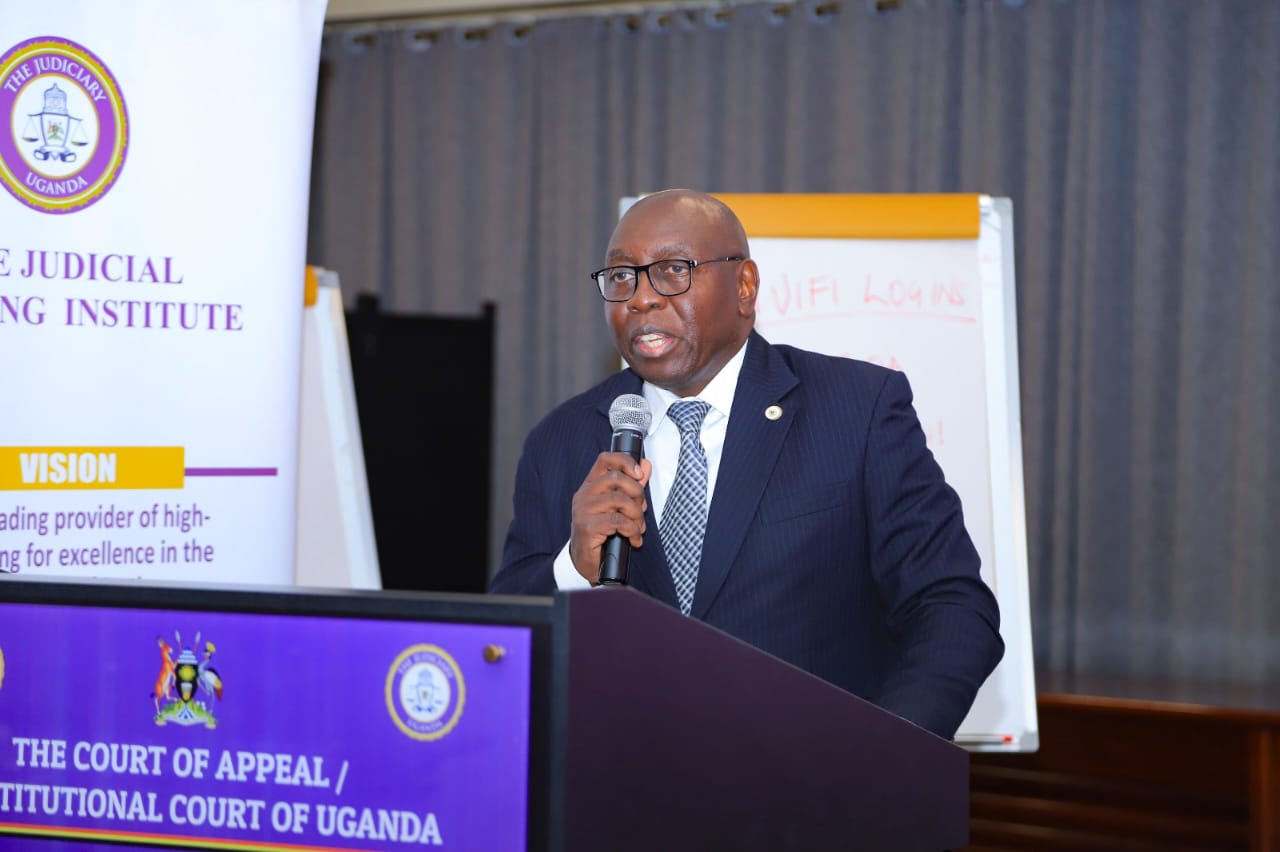
The Judiciary has commenced training sessions for judges on a newly developed Judgment Writing Tool aimed at tackling persistent case backlog and delays in the administration of justice.
According to Geoffrey Kiryabwire, Chairperson of the Judgment Writing Tool Committee, judges currently spend more than 70 percent of their time drafting judgments — a process he described as highly time-consuming.
“Judges have between 500 to 600 cases that they handle and each of these needs a judgment to be written. Judgment writing, by the way, takes 70 percent of the time taken to handle a case,” Justice Kiryabwire said.
He noted that the heavy workload has significantly contributed to case backlog, with some matters remaining unresolved for years, thereby undermining access to timely justice for many Ugandans.
To mitigate this challenge, the Judiciary has introduced the digital tool to streamline the drafting process. The system incorporates structured templates and guided features intended to help judges prepare well-reasoned judgments more efficiently and consistently.
Ms Caroline Obbo, Associate Researcher at the LexisNexis Rule of Law Foundation, said the tool will also expand judges’ access to legal research materials.
“This judgment writing tool has templates that can be used by judges to write judgments faster and swiftly,” she said.
She added that the platform provides access not only to Ugandan laws but also to regional and international legal materials, enabling judges to conduct adequate research before delivering verdicts.
“The writing tool has access to not only Ugandan laws but also regional and international laws, thereby helping a judge make adequate research on cases before the verdict,” Ms Obbo reiterated.
By integrating these legal resources into a single platform, Judiciary officials say the system will enhance both efficiency and consistency in judicial writing.
Beyond research support, the tool also functions as a database of certified lawyers. This feature will allow judges to verify advocates appearing before them, helping to curb the practice of uncertified individuals presenting themselves in court.
Despite its advanced capabilities, Justice Kiryabwire emphasized that the system is not designed to replace judicial reasoning. He cautioned judges against misuse, stressing that the tool cannot independently write judgments but serves strictly as an aid to support judicial work.
The Judgment Writing Tool was developed by the Judiciary with support from the LexisNexis Rule of Law Foundation at a cost of over Shs2.2 billion.
Although the system is expected to roll out soon, demonstrations have revealed some systemic and administrative challenges that still need to be addressed.
Judiciary officials, however, describe the platform as a “living instrument” that will continue to be refined. Once fully implemented, it is expected to significantly transform judgment writing and improve efficiency within Uganda’s justice system.
